From Firebase in 2013 to Firebase in 2026
I first came across Firebase in 2013.
At the time, I wasn't trying to build a production system. I was simply curious about how Firebase worked.
Firebase had tutorials, so I followed those and built a small chat application. I wanted to understand how data was written and read, and how changes could appear in the application within a fraction of a second.
That was enough to get my attention.
I wasn't thinking about architecture, production workloads, security rules, analytics or Cloud Functions. I was just experimenting with realtime data.
I didn't know then that a few years later I would be pitching Firebase for a real production application.
And I definitely didn't expect that, more than a decade later, I'd be using Firebase in conversations about Gemini, MCP and AI assisted development.
Firebase was already solving an interesting problem
It would be easy to look at Firebase from 2026 and describe the early version as simply a realtime database.
That would be an oversimplification.
In a 2013 Firebase article, the Firebase team described several ways developers could use it: as the backend for an entire application, alongside server side code, or alongside an existing application to add realtime functionality such as chat, notifications and comment feeds.
The idea was already quite powerful.
Instead of every application starting with:
How do I build and maintain the backend?
Firebase offered another possibility:
How much of the backend do I actually need to build myself?
That was the part I found interesting when I first learned it.
I could write some data. Another client could receive it. And I didn't have to start by building all the infrastructure that made that possible.
Firebase Hosting launched in 2014, and later that year Firebase joined Google. That gave the platform a much bigger foundation to build on.
In 2017, Firebase became a production decision for me
My relationship with Firebase changed when I started learning React Native in 2017.
One of the projects I was working on needed 1:1 and group chat.
It wasn't just a basic text chat. We needed text, images, videos and location sharing.
I pitched Firebase to our CEO and the client. They agreed, and we used Firebase heavily in production for the chat functionality.
This was very different from the small chat application I had built while learning.
Back then, I was asking:
Can I make this work?
Now I had to ask:
Can I trust this in a real product?
That changes how you evaluate a technology.
Authentication matters. Data modelling matters. Storage matters. Notifications matter. Failures matter.
The same technology I had used to understand realtime data had become something I was comfortable recommending for an actual product.
That was an important shift in how I looked at Firebase.
Firebase became much more than a backend
Over time, Firebase expanded beyond its original realtime backend focus. In 2016, Google described Firebase as a unified platform for building mobile and web applications, with services covering areas such as analytics, app quality and user engagement in addition to its backend capabilities. Firebase's 2016 platform announcement
I experienced that evolution through the projects I worked on.
Over the years, I've used almost the entire Firebase ecosystem in different applications: Realtime Database, Firestore, Authentication and phone verification, Cloud Messaging, Storage, Cloud Functions, Hosting, Analytics, Crashlytics, Remote Config and App Check.
At some point, Firebase stopped being a single service I used for a particular feature.
It became infrastructure that touched multiple parts of an application.
That is probably the clearest way I can describe the change from my own experience.
Firebase went from being something I experimented with to something I could use across the application lifecycle.
The Firebase I use today is very different
Firebase now covers databases, authentication, storage, server side logic, hosting, security, analytics, crash reporting, remote configuration and other application services. It also has Firebase AI Logic for integrating Gemini into mobile and web applications.
The important change isn't simply the number of products.
It's the amount of infrastructure Firebase can abstract.
The original promise was roughly:
Don't build your own backend.
The broader promise today is closer to:
Don't build every piece of application infrastructure yourself.
That's a much bigger abstraction.
And it changes the questions developers need to ask.
Earlier, I might have asked:
Where should I store this data?
Today, I also need to think about security, monitoring, configuration, deployment, cost and what should happen as usage grows.
The platform handles more of the infrastructure.
The engineering decisions don't disappear.
Then AI became part of the application
This is where Firebase in 2026 starts to feel very different from the Firebase I first learned.
Firebase AI Logic lets applications integrate Gemini models through Firebase SDKs for Android, iOS, Web, Flutter and Unity. It supports multimodal inputs and capabilities such as chat, function calling, image generation and speech.
What interests me isn't simply that Firebase now has AI.
It's that AI is becoming part of the same application infrastructure.
An application can have:
Authentication → Database → Storage → Functions → AI
instead of treating AI as a completely separate system.
And once you put AI into a real application, the same production questions come back.
How do I control access? How do I manage costs? How do I handle failures? How do I change configuration without releasing a new application?
Firebase's current production guidance recommends using controls such as App Check and Remote Config or server prompt templates for AI features.
Calling an API is easy.
Building something that users can depend on is harder.
I learned that lesson with Firebase years ago, and AI is bringing it back in a different form.
Now AI can work with Firebase too
This is probably the most interesting change for me personally.
Firebase isn't only being used by applications that contain AI. AI development tools can now work with Firebase itself.
Firebase provides an MCP server with prompts, resources and tools that allow compatible AI agents to work directly with Firebase projects, with developer approval. The available workflows include things such as Firebase initialization, deployment, Firestore Security Rules and Crashlytics.
That changes the interaction model again.
In the early days:
Developer → Firebase
Then:
Application → Firebase
Now we're increasingly seeing:
Developer → AI agent → Firebase
This is a meaningful shift.
The AI isn't only generating Firebase code in a text editor. With the appropriate tooling and permissions, an AI development environment can interact with the Firebase project itself.
This is also where my recent work with Firebase MCP has changed the way I think about the platform.
The question is no longer only:
What can Firebase do for my application?
It is also:
What can an AI agent do with Firebase on my behalf?
And that leads to a new set of engineering questions.
What should an agent be allowed to change?
What permissions should it have?
How do we review its changes?
Which operations are safe to automate?
Where should a human still be in the loop?
The abstraction is getting higher, but the responsibility hasn't disappeared.
The abstraction changed. The engineering didn't.
This is probably the biggest lesson I take from looking at Firebase across these years.
Abstraction reduces implementation work. It doesn't remove engineering responsibility.
When I was learning Firebase in 2013, the impressive part was being able to write data and see it appear somewhere else almost immediately.
When I started using Firebase in production, I had to think about architecture, authentication, storage, notifications, failures and everything around real users depending on the system.
Now, with AI, the same principle applies again.
Gemini can make it easier to add an AI feature. AI coding agents can make it easier to write and configure software. Firebase can provide more of the infrastructure around both.
But someone still has to decide what should be built, how it should be structured, what permissions an agent should have, how the system should behave when something goes wrong, and whether the architecture actually makes sense.
The abstraction moves the work.
It doesn't eliminate the need for judgment.
Looking back from 2026
When I think about my Firebase journey, there are three moments that stand out.
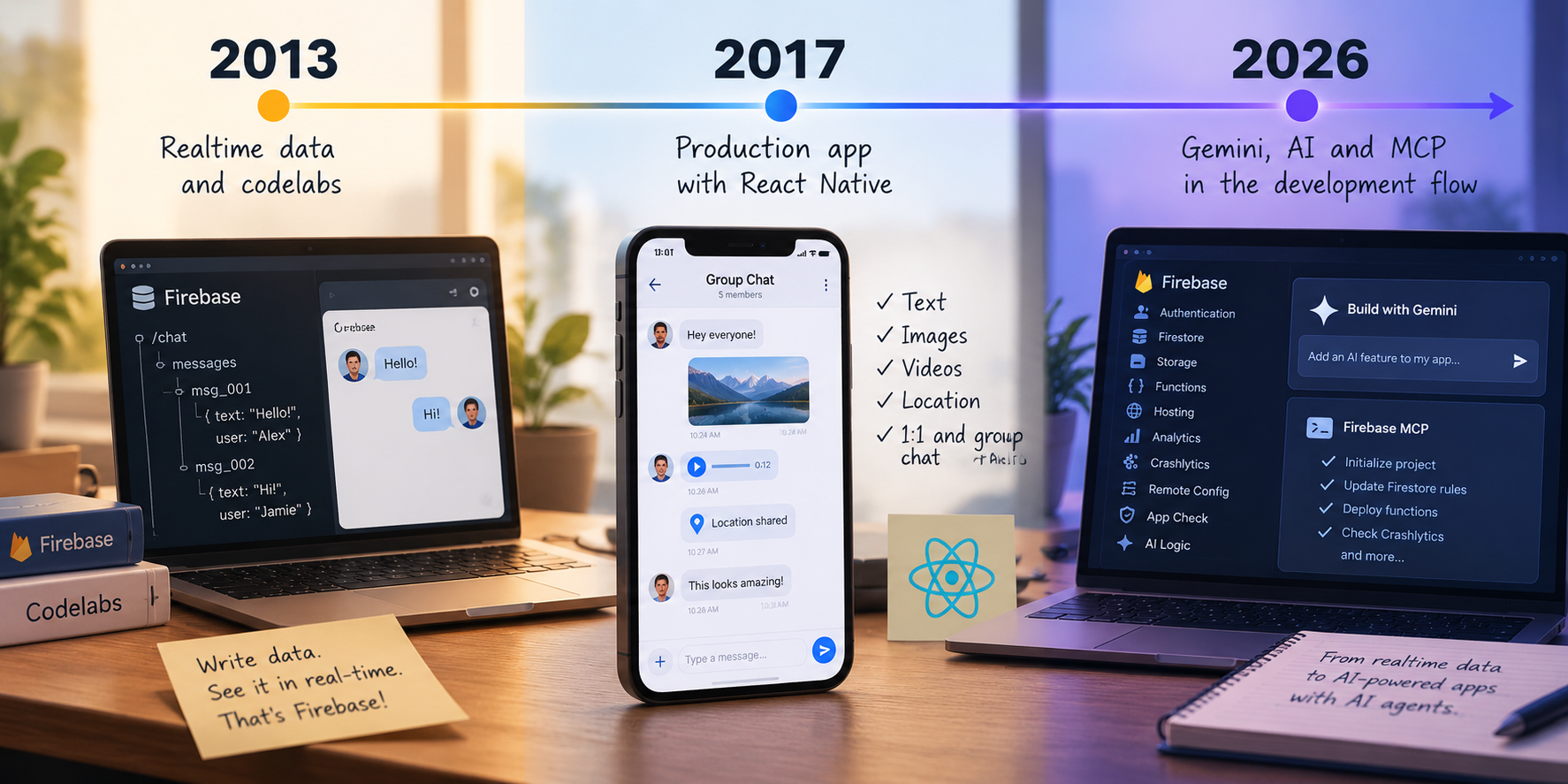
2013: I was learning how realtime data worked. I built a small chat application because I was curious.
2017: I was learning React Native and needed chat for a real product. I pitched Firebase to our CEO and client, and we used it heavily in production for 1:1 and group chat, including text, images, videos and location sharing.
2026: Firebase is part of a much broader development stack. It can provide application infrastructure, integrate Gemini capabilities, and increasingly give AI development tools a way to interact with Firebase projects.
That's a pretty significant journey but the underlying idea feels surprisingly familiar. Developers don't really want more infrastructure, they want to build products.
In 2013, Firebase helped me spend less time building backend infrastructure.
In 2017, it helped me build a real product feature without building an entire messaging backend from scratch.
In 2026, it is becoming part of a world where AI can help build the application itself.